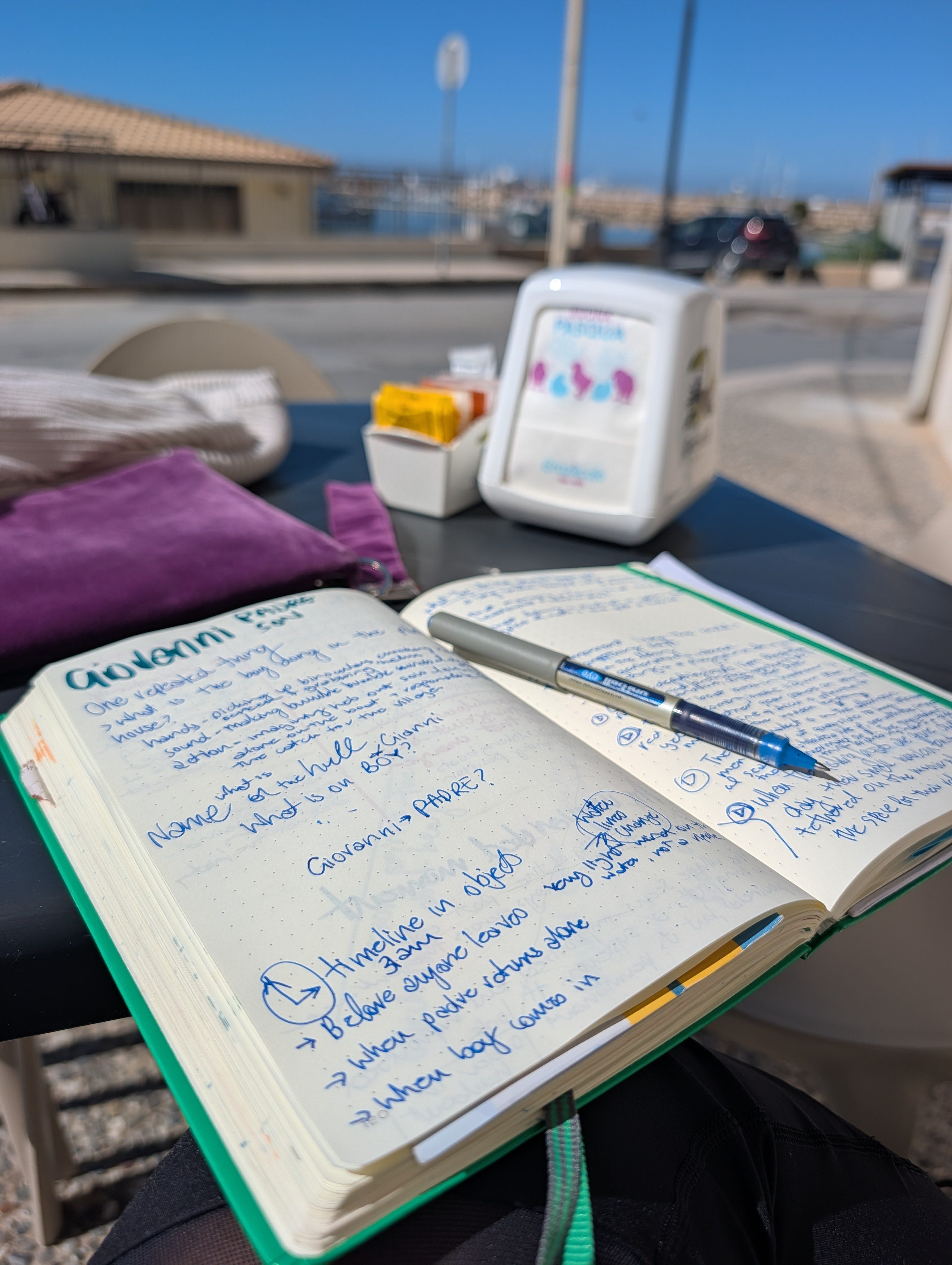


Between one and three in the morning, they leave.
We are asleep on Cooee, our sailboat, moored some metres away in the same harbour, and their engines are kept so low and the lines slipped so quietly that by the time the sky begins to lighten the boats are already past the breakwater and out into the Strait of Sicily, somewhere in the dark water between this small Sicilian town and the coast of Africa. We wake to rope ends where boats were, and the faint smell of diesel hanging on still air, and a harbour that feels less like emptiness than like intention. They are out somewhere. They are working. They will be back.
Scoglitti is a fishing village on the southern coast of Sicily, and still one, though the fleet is smaller now than it was, regulations changed what was possible some years ago, and some boats didn’t come back from that. But the ones that stayed are still going out every morning before the town stirs, still slipping their lines in the dark, still reading the same water their grandfathers read. That is the fact worth holding onto, and it is the fact this harbour keeps quietly insisting on, if you stay long enough to hear it.
Their boats carry the names they were given > Santa Maria, La Madonnina, Giovanni Padre, and Gianni Boy. From saint to patron, from father to son, each name a rung on the same ladder, the same family climbing it in the same water for longer than anyone can clearly remember. The names are not decorative. They are a record of what matters most to the people who painted them there, in plain block letters on working hulls, in a harbour on the edge of Europe where the sea has always been both the livelihood and the love.
The harbour itself is clean in a way that feels deliberate, tended. The water is clear enough in the morning light to see straight to the bottom, green with weed, the hulls of the moored boats lying in perfect reflection on the surface, the real and the mirror image so still and close that you have to choose which one to look at. The breakwater holds the sea back and the town holds the land back and between them there is this flat, quiet, looked-after water where the boats rest, held by long lines running back to shore, bounded but afloat, connected to the land without ever quite touching it.
The afternoons in Scoglitti belong to the boats coming home. Padre comes back first, around noon, and I watch from Cooee‘s deck as the man in yellow overalls takes his position at the bow before the engine has finished slowing, a long hook already in his hands, reaching out across the water to catch the mooring line his tender has been holding all day. He hauls it in and makes it fast with the easy efficiency of someone who has made the same gesture ten thousand times, and the boat settles in the middle of the harbour, not against a dock, not touching land, but held in open water in exactly the right place. Giovanni Boy comes back around three. By four o’clock the fish market is running along the dock, the last crates coming off the last boat, small vans pulling up in the late light, one of them with a little mermaid painted on the side, and the handlers and the buyers and the people of the town stand together talking and gesturing and sometimes holding a beer while the sun goes long and gold across the water.


Giovanni Padre is the formal name, the father boat I like to think. Blue hull, white above the waterline, rust running in long vertical streaks below the lettering the colour of sweat on a brow, which is what it is… the honest visible record of a working life in salt water. Beside him, Gianni Boy, the same boat a generation newer, a little higher in the water, the name shortened the way you shorten a name for someone you love when they are small. Giovanni becomes Gianni and Padre becomes Boy. The boats are the relationship made visible, moored side by side in the same water they have always shared.
On the wall of the harbour authority building, which is also where the lighthouse sits, there is a ceramic tile. The lighthouse is a modest thing, a small stepped tower of white concrete, three tiers decreasing upward, rising above blue-shuttered windows that are the exact same blue as Giovanni Padre’s hull, and you would almost walk past it if the Madonna were not there on the wall beneath it, watching. The Madonna of Porto Salvo, patron saint of the sea, rendered in (I think) a hand-painted ceramic tile, standing above two fishermen in a small wooden boat with nets over the side. 180th anniversary,1834 to 2014. She has been watching this harbour for nearly two centuries, through everything it has been and everything it has lost, and she is watching it still.


The afternoon I saw the little boy child, Giovanni Boy had come in and was moored and quiet in the flat harbour light. He was small, perhaps five years old, perhaps six, and he was in the pilot house with both arms raised to the wheel, which was too wide for him by at least half, his chin barely level with the instrument panel. His mouth was making the sound, the low diesel rumble bumble he has heard a hundred times lying in the bow in the dark while his grandfather steered them out before sunrise, the sound that means the sea, that means the work, that means the men he loves going somewhere important and coming back. He was not playing, he was practicing.
I was walking past on the dock and I stopped. There is a particular kind of joy that arrives without warning, the kind that belongs entirely to someone else and lands in your chest anyway without asking permission, a small boy on his father’s boat, on his grandfather’s water, already inside the mythology that will be told at Sunday lunch for the rest of his life. The adventures at sea. The men who left before the town woke and came back in the afternoon light with the catch that fed the village. He already knows he is part of that story. He is steering himself into it right now, alone in the pilot house, the harbour still, the engine quiet, going nowhere and already on his way.
I stood there one breath too long, then walked on…
Later, when the market has sold its last crate and the vans have pulled away and the harbour has settled into the particular quiet of a working day finished, I see one of the fishermen climb down into his small wooden tender, lower himself onto the middle thwart, and take a fishing rod from somewhere beneath the seat. He is not going anywhere. The tender rocks once, twice, and is still. He casts his line into the same water he spent twelve hours working before the sun came up, and he waits, and the harbour goes quiet around him, and the light falls slowly across the water, and there is nothing in his posture that suggests he would rather be anywhere else.
He is exactly where he wants to be. Thanks for drifting with me.